Why Browser-Based Social Deduction Games are Winning the Party Scene

Discover why online social deduction games are taking over the party scene. Explore the best bluffing games similar to Werewolf for your next large group event.
The Evolution of Social Deduction from Tabletop to Browser
Social deduction games have quietly become the most socially charged genre in gaming — built on hidden roles, calculated bluffing, and the electric tension of not knowing who to trust.
At their core, social deduction games are structured around asymmetric information: some players know a secret the group doesn’t, and everyone must argue, accuse, and observe their way to the truth. The genre traces its roots to Mafia, a 1986 psychology experiment turned parlor game, followed by Werewolf, which popularized the hidden traitor format at conventions and campfires through the 1990s and 2000s. Modern digital titles carried that legacy forward, turning the same core mechanic into a global phenomenon.
The hidden traitor mechanic works as an icebreaker because it gives strangers a structured reason to interact. No one needs shared history or inside jokes — the game creates the drama. That dynamic scales remarkably well for large groups, where organic conversation can stall but accusation and defense flow naturally.
What’s changed most recently isn’t the gameplay itself — it’s the delivery. The new gold standard is frictionless gaming: no box to unpack, no cards to shuffle, no moderator required. Browser-based platforms have stripped away every barrier between “let’s play something” and the first round starting. The global social deduction market hit $1.62 billion in 2024, projected to grow at 9.3% annually through 2033 — and much of that momentum is being driven by digital-first formats. That shift toward mobile and browser play deserves a closer look.
Why Mobile is the New Home for Hidden Traitor Games
Mobile has become the dominant platform for social deduction gaming — and the numbers make it impossible to argue otherwise. According to Mordor Intelligence, mobile devices commanded 71.55% of the social gaming market share in 2025. That shift didn’t happen by accident. It happened because the best social deduction games are built around reading people, not mastering complex interfaces — and a touchscreen in someone’s hand is all the hardware that requires.
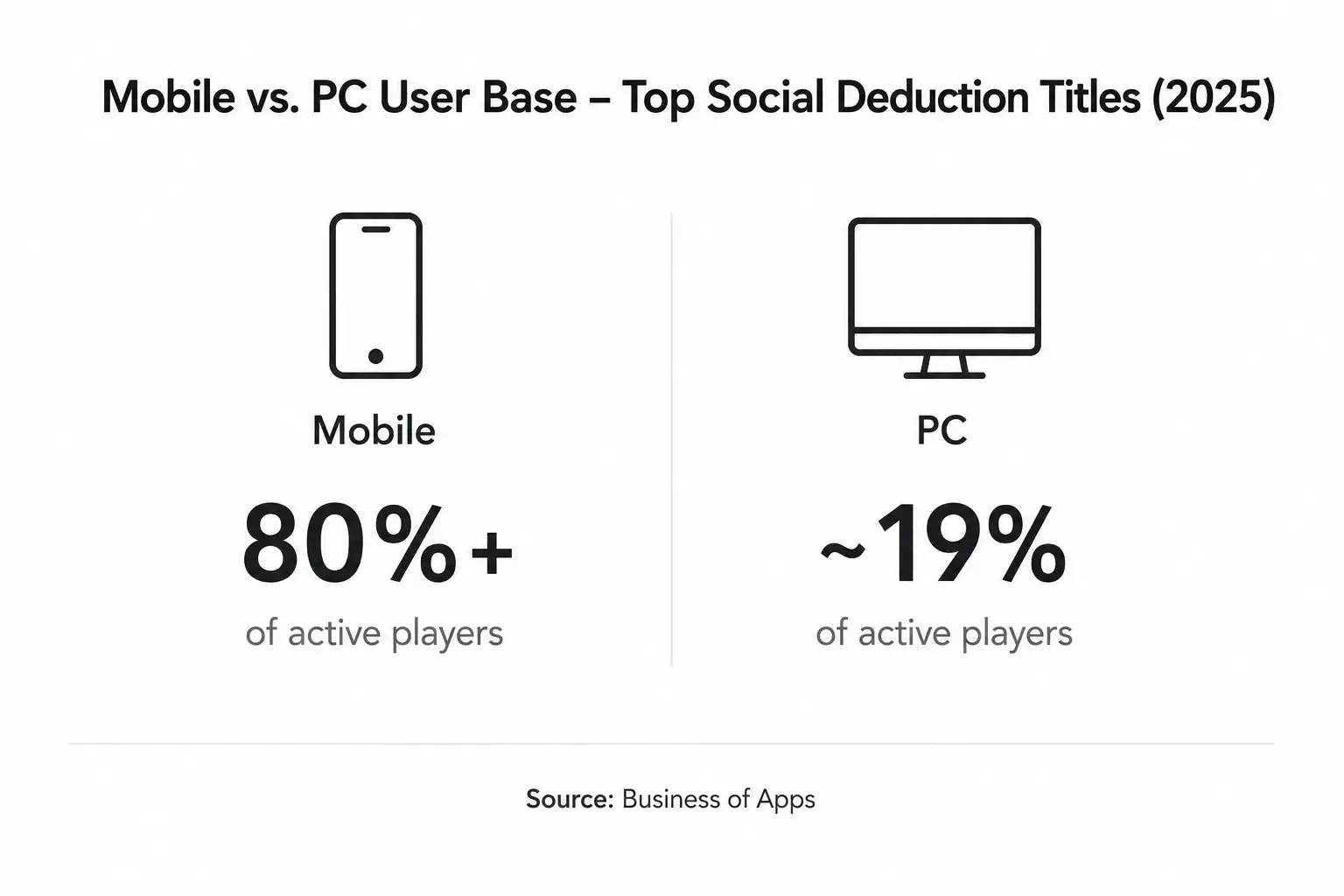
The appeal of the one-tap mechanic is central to this trend. Casual players don’t want to navigate menus or remember keybindings. They want to tap a role card, glance at their assignment, and immediately start lying to their friends. That frictionless entry point is exactly why titles with simplified mobile interfaces have overtaken their PC counterparts in sheer reach. Business of Apps reports that mobile players account for over 90% of the user base for top social deduction titles — compared to just 3% on PC.
Beyond raw numbers, mobile gaming fits how people actually socialize. A road trip, a backyard barbecue, a holiday gathering — these moments don’t come with a gaming PC. Having a game perpetually in your pocket means the fun can start the moment someone says “what should we do?” That kind of always-available convenience has made mobile the default choice for spontaneous group play. It also raises a practical question: if everyone already has a phone, why should anyone need to download anything at all?
The Problem with App Stores: Solving ‘Wallet and Storage Fatigue’
The biggest party killer isn’t a bad game — it’s watching 10 people stare at a loading bar while a 200MB app crawls onto their phones. Anyone who’s tried to launch a group game night knows this moment intimately. One person has Android, another has an older iPhone with no storage, someone else refuses to hand over their Apple ID password. What was supposed to be a spontaneous, fun experience grinds to a halt before a single card is drawn.
Mandatory account creation compounds the friction. Even when the download completes, many apps require email registration, age verification, or a linked social profile before you can play. For a casual party setting, that’s a dealbreaker. Privacy-conscious guests shouldn’t need to surrender personal data just to join a round of online social deduction games with friends.
Browser-based play eliminates both problems at once. As Barrett Media notes: “The trade-off between downloadable and browser games is that downloadable games eat storage space… For users who wish to engage in a more social and uniform experience, the browser provides the ideal solution.” A shared link replaces the download entirely — tap, play, done.
Uniformity is the underrated advantage here. Web apps render consistently whether someone’s on a budget Android device or a flagship iPhone. There’s no “it looks different on my phone” problem, and no one gets left out because their OS version is too old. For parties where the goal is zero-setup group fun, that cross-device reliability isn’t a nice-to-have — it’s essential. As groups scale up in size, that consistency becomes even more critical, which is exactly what the best large-group social deduction games are built around.
Top Social Deduction Games for Large Groups and Parties
The right game for a large group isn’t just about fun — it’s about zero friction, no missing pieces, and rules anyone can grasp in 90 seconds.
For groups craving classic hidden-role tension, Werewolf variants remain the gold standard. Games similar to werewolf offer a familiar push-pull between deception and deduction that scales naturally with crowd size. The core loop — identify the hidden threat before time runs out — is intuitive enough that newcomers contribute from round one, while veteran players can layer strategy on top.
Mr. White earns its spot for groups that want a word-association challenge without appointing a dedicated game master. With over 200 word pairs and adjustable difficulty settings, it tailors itself to the room rather than forcing the room to adapt to it. That flexibility is especially valuable for parties where skill levels vary wildly. Categorized word lists — think food, movies, travel — are what make replayability possible; without them, groups exhaust content fast and drift away from the game entirely. Even no-setup party formats benefit from this kind of built-in variety.
For 10+ players, table-free browser games have a clear structural advantage. No board to crowd around, no cards to shuffle, no moderator standing awkwardly apart from the group. Everyone stays in the conversation — which, in social deduction, is exactly the point.
| Best For | Game Style |
|---|---|
| Classic role-play fans | Werewolf variants |
| No game master needed | Mr. White |
| 10+ players, no table | Browser-based word games |
| High replayability | Games with categorized word lists |
Knowing which game fits your crowd is half the battle — the other half is knowing how to run it smoothly.
How to Host a Flawless Social Deduction Game Night

The difference between a game night that people talk about for weeks and one that fizzles out is almost always preparation — not luck.
Hosting social deduction games for large groups comes with a short but critical checklist. Get these four things right, and the evening runs itself.
-
Choose a narrator-free game. Games that require one person to sit out and moderate kill the energy fast. Look for formats where the app or browser handles all the role assignment and timing, so everyone — including the host — stays in the action.
-
Confirm offline or low-data capability before you arrive. Road trips, rooftop venues, and basement hangouts often mean patchy Wi-Fi. As Barrett Media notes, browser-based games load instantly and disappear once the tab is closed — but you still want to confirm the game caches correctly before the first round begins.
-
Start entry-level, then layer in complexity. Open with a straightforward round where roles are self-explanatory. Once the group is warmed up, you can introduce asymmetric roles or shorter time limits. You can walk through how roles and rules work ahead of time to cut the learning curve further.
-
Commit to a single-device, pass-and-play model. One phone circling the table keeps eyes up and conversations loud — the exact opposite of everyone buried in their own screen.
Pro-Tip: Run a silent test round before guests arrive. Tap through every role screen yourself so you can answer questions without breaking the group’s momentum.
With the logistics locked down, it’s worth stepping back to consider what actually makes these games work at a deeper level — and why the format keeps gaining ground.
The Bottom Line: What You Need to Know
Social deduction games are winning the party scene because they put conversation at the center — not cardboard, cables, or app stores.
Here’s a quick summary of everything that matters before you plan your next group night:
- Interaction beats equipment. Social deduction games are the fastest-growing segment of party entertainment precisely because the “game” is the people in the room. No elaborate setup means no friction between arriving and actually having fun.
- Mobile social deduction games outperform boxed alternatives at parties because they eliminate the two biggest momentum killers: downloading an app and creating an account. Browser-based tools load instantly on any phone and get out of the way.
- Pass-and-play mechanics are a party superpower. Look for games that let one device circulate around the group — Mr White does exactly this, keeping everyone engaged without requiring each player to own a device or manage their own screen.
- Ease of teaching and fast resets define the best large-group games. If explaining the rules takes longer than one round, you’ve already lost half the room. The strongest options are those a newcomer can grasp in seconds and that reset for the next round just as quickly.
In practice, the simplest tool is usually the one that gets played the most. A game that works across every kind of gathering — from casual hangouts to milestone celebrations — earns its place as a go-to. That’s the bar worth measuring against.
Why Mr White Online is the Ultimate Party Shortcut
The best party game is the one nobody has to wait for — and that’s exactly what a free, browser-based platform delivers.
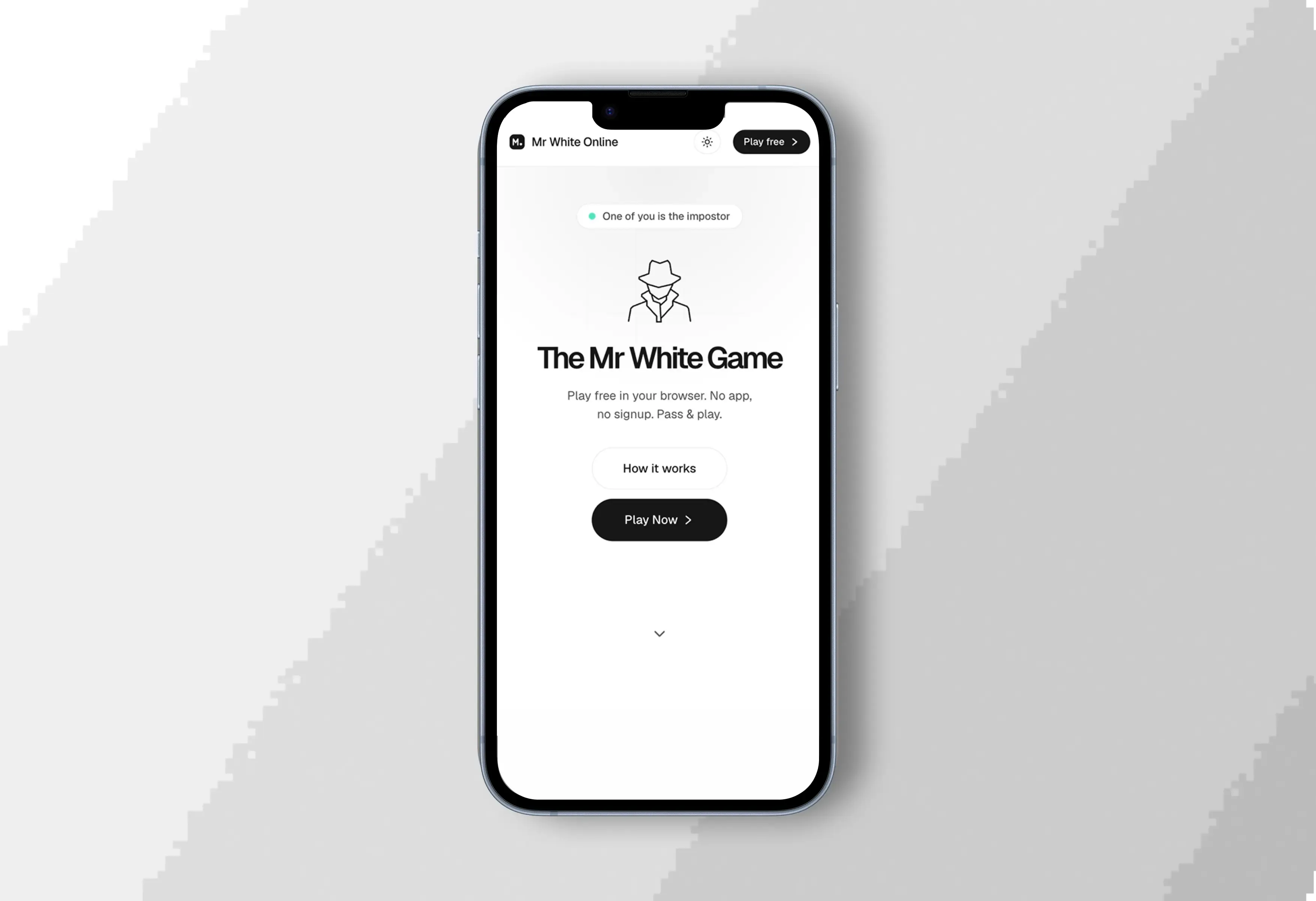
No download, no account, no barrier between your group and a great round. Mr White Online runs entirely in your browser and is fully optimized for mobile, meaning anyone at the table can join within seconds, whether they’re on a phone, tablet, or laptop. The platform is free by design, which removes the awkward moment of asking guests to pay before they’ve even played.
The depth of content backs that instant accessibility. With 200+ word pairs built into the game, hosts never stare at a blank screen trying to invent prompts on the spot. Every round feels fresh because the vocabulary does the work — players just bring the suspicion, the bluffing, and the laughter. That library alone sets the experience apart from improvised alternatives.
Social deduction games endure because they make every person at the table the entertainment. No screen dependency, no rulebook marathon — just conversation, reading faces, and deciding who to trust. In practice, that’s a rare thing for any game to pull off.
If your group is looking for its next go-to, try a round right now — the only thing standing between you and a great game night is hitting start.