The Real Reason Your Youth Group Games Fail (And How to Fix the Friction)

Stop the momentum killers in your ministry. Learn how to fix common setup mistakes and lead engaging youth group team building activities that actually work.
The Friction Problem: Why Most Youth Group Games Flop
The single biggest killer of youth group energy isn’t a bad game — it’s the setup that precedes it.
Youth leaders know the moment well: you announce a game, and instead of excitement, you get blank stares, fumbling phones, and the slow death of momentum. Whether you’re running youth group icebreakers for small groups or scaling up group games for adults, the pattern repeats. Someone can’t get the app to load. A prop is missing. Dead air stretches into awkward silence — and that silence is where engagement goes to die.
The “app download” barrier alone can sink an entire session before it starts. Mobile game uninstall rates average 1.5% on the very first day among non-core audiences, and that friction compounds fast in a group setting where even one person struggling derails everyone. Prop-heavy games carry their own version of this problem: hauling supplies, counting pieces, explaining rules — every extra step is a door that can close on participation.
The gold standard for modern youth engagement is zero-friction play: games that launch in seconds, require no downloads, and need nothing but the people in the room. Tools like browser-based social deduction games point directly toward this model — accessible instantly, no installation required.
Many users are less likely to return after a single bad experience — and teenagers are no exception. The friction problem isn’t incidental. It’s structural. Understanding what creates it is the first step toward fixing it — which means looking at what a healthy youth ministry program actually needs games to accomplish.
The 7 Components of Youth Ministry Success (and Where Games Fit)
Effective youth ministry isn’t built on a single activity — it runs on seven interconnected components, and games are the engine that gets all of them moving.
According to a widely recognized youth ministry framework, a balanced program rests on these pillars:
-
Worship — connecting students to something larger than themselves
-
Fellowship — building authentic community and belonging
-
Discipleship — nurturing personal and spiritual growth
-
Ministry — empowering teens to serve others
-
Evangelism — sharing values and inviting others in
-
Prayer — cultivating reflection and inner life
-
Leadership — developing the next generation of influencers

Of these seven, Fellowship is the gateway component. Without it, the other six struggle to take root. A student who doesn’t feel connected won’t engage in discipleship, won’t volunteer for ministry, and definitely won’t invite a friend. Fellowship isn’t a warm-up act — it’s the foundation.
This is exactly where youth group team building activities earn their keep. A well-chosen game doesn’t just fill time between announcements; it manufactures the shared experience that makes genuine connection possible. In practice, the difference between forced fun and real bonding comes down to game design. Activities that require communication, trust, or collective problem-solving create social glue in minutes — not months.
What’s interesting is that the type of game matters as much as the game itself. And that leads directly to why social deduction and word-association formats do something that most icebreakers simply can’t.
Social Deduction: The Ultimate Workout for the Teenage Brain
Games like Mr White aren’t just fun fillers — they’re doing serious developmental heavy lifting every time teenagers play them.
When youth leaders think about how to engage youth in church, the instinct is often to reach for loud, physical games. But social deduction games offer something more lasting: a genuine workout for the prefrontal cortex. Think of the prefrontal cortex as the brain’s “responsible adult” — it manages decision-making, impulse control, and reading other people. It also happens to be the last region to fully develop, which is basically the universe’s way of explaining every group chat your teenagers have ever sent. Games built around bluffing, deduction, and hidden roles force this part of the brain to stay switched on throughout every round.
Social deduction games function as exercises in Theory of Mind — the ability to understand that other people hold beliefs, intentions, and knowledge different from your own. When a teenager decides whether to trust a classmate’s alibi or call their bluff, they’re practicing empathy at speed. As a credible source notes, these games require youth to manage complex information and read social cues simultaneously, turning casual play into active social-emotional learning.
Word association elements — core to games like Mr White — layer on a second benefit. As one education researcher puts it:
“Every game is a language lesson disguised as play. Kids absorb new words and practice clear communication while thinking they’re just having fun.” — an education researcher
That’s a meaningful contrast to passive screen time, where teenagers consume content without producing anything social in return. Social deduction formats flip that dynamic entirely — every player is simultaneously a performer and an analyst, which is precisely the active engagement youth ministry needs.
Understanding why these games work cognitively also gives youth leaders a confident answer when parents or church leadership ask about the program’s value. The next step is knowing which specific games deliver that value with zero budget and zero setup time.
The ‘Ultimate Survival Guide’ to Zero-Prop Group Games for Kids
The best group games for kids are the ones that start the moment you say “go” — no bags to unpack, no batteries to find, no rules sheet to photocopy.
Zero-prop games don’t just save time; they remove the single biggest barrier between a distracted teenager and genuine engagement. Observations suggest that logistical friction causes around 40% of participants to mentally check out before an activity even begins. When setup disappears, that dropout window closes entirely.
Classic no-prop formats like Mafia and Werewolf have anchored youth programming for decades precisely because they demand nothing but people and a willingness to suspect your best friend. Their modern digital evolution takes that same social tension and packages it for a single shared screen — meaning one device handles the role distribution that used to require a shuffled deck of index cards.
The pass-and-play advantage is genuinely underrated for large-group settings. One device moving around a circle is more socially cohesive than twenty kids staring at separate phones. It forces eye contact, creates shared anticipation, and naturally scales from a living room of eight to a church hall of forty without a megaphone or a line-item budget. For leaders running games without a supply list, this single-device model is the practical default worth building around.

The arc from icebreaker to deep session matters too. A quick identity-guessing round at the start of the evening lowers social anxiety; the same deduction mechanic stretched into a longer elimination game with discussion rounds builds genuine team cohesion. The format does both — which is exactly why the right digital tool to support it deserves a closer look.
Why Mr White is the ‘Youth Book’ of Digital Social Deduction
The best fun group games for youth ministry share one quality: they remove every excuse not to play. Mr White Online is built around that principle from the ground up — a free-to-play, browser-based social deduction game that requires zero downloads, zero accounts, and zero “I forgot my password” moments before the session even starts.
No app store friction means the game begins the second someone opens a browser.
The pass-and-play mechanic is where Mr White Online earns its place at every youth gathering. One device gets passed around the circle — each player sees only their own word before handing it off. That single design choice keeps phones from becoming a distraction and keeps every player physically present in the group. It’s specifically engineered for the kind of shoulder-to-shoulder social settings youth leaders are trying to create.
Fresh content is another practical advantage. With over 200 categorized word pairs, leaders can run the game week after week without the group cycling through the same prompts. Variety keeps the “language lesson” alive and the social dynamics genuinely unpredictable.
Traditional App | Mr White Online | |
|---|---|---|
Setup time | 5–10 min (download, accounts) | Under 60 seconds |
Device requirement | One per player | One shared device |
Offline play | Rarely supported | Yes — browser caches |
Cost | Often freemium | Free |
That offline capability matters more than most leaders expect — church basements and charter buses aren’t known for reliable Wi-Fi. When the connection drops, the game doesn’t have to.
The Bottom Line: How to Engage Youth Without the Headache
The fastest way to kill engagement in large group games is friction — and the fix is simpler than most leaders realize.
After exploring zero-prop formats and digital social deduction tools, a clear pattern emerges. Every strategy that works shares the same foundation: remove the barriers first, then let the connection happen naturally. Research supports this — groups that eliminate setup hurdles see a significantly higher return rate for future social events, which means your first frictionless session directly shapes whether teenagers show up again next week.
Here are the four principles worth taking into every planning conversation:
-
Zero-friction is non-negotiable. Engagement starts in the first minute. If teenagers are standing around waiting, you’ve already lost the room.
-
Social deduction builds real skills. Games that require players to read, bluff, and communicate develop Theory of Mind — the ability to understand what others are thinking — in a low-stakes, high-fun environment. Social deduction mechanics do the heavy lifting without any lecture required.
-
Browser-based tools remove every technical excuse. No downloads, no accounts, no dead batteries. One device, one link, one game running in seconds.
-
Fellowship is the foundation. Activities are the vehicle, not the destination. When the game disappears and teenagers are still talking, laughing, and trusting each other — that’s the win.
The tool doesn’t matter if the environment isn’t right; the environment doesn’t come together without the right tool.
With these principles in place, the only question left is how to put them into practice with a real group on a real night — which is exactly where the next section picks up.
Why did the youth leader bring a laptop to camp? Because they finally found a game that works without an extension cord. 🎉
Next Steps: Your First Zero-Friction Session
The right tool turns a skeptical group of teenagers into willing participants faster than any icebreaker script ever could. When big group games remove setup barriers entirely, resistance dissolves on its own.
Introduce the game before you need it to work. A common pattern is to demo the concept during a low-stakes moment — a five-minute gap before a meeting starts, or the tail end of a road trip. Teenagers who feel like they discovered a game themselves are far more likely to champion it to their peers than those who feel like something was organized at them.
The “One Device” rule changes the energy in the room. Designate a single shared screen as the game controller and ask everyone else to pocket their phones. This isn’t about restriction — it’s about focus. When one device drives the action, eyes come up and the social dynamic shifts immediately. Mr White Online is built precisely for this: a free-to-play web app with categorized word lists and adjustable difficulty, running entirely in a browser with nothing to download or configure.
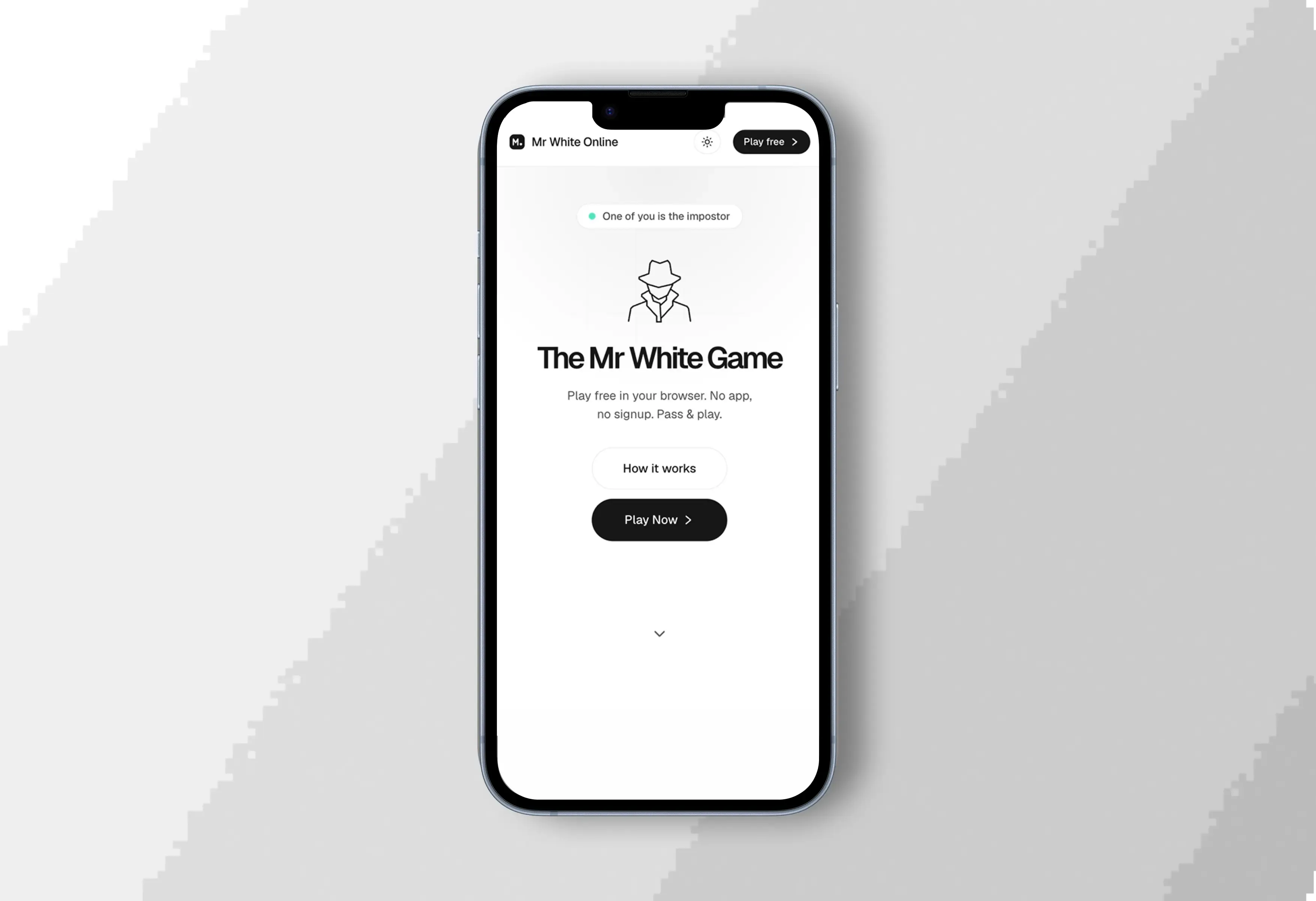
In practice, leaders who try this approach once rarely go back to heavier alternatives. You don’t need a thick survival guide to run an engaging session — you need a tool that handles the logistics so you can handle the people. Give it a run at your next meeting and let the game do the work.
Key Takeaways
-
Worship — connecting students to something larger than themselves
-
Fellowship — building authentic community and belonging
-
Discipleship — nurturing personal and spiritual growth
-
Ministry — empowering teens to serve others
-
Evangelism — sharing values and inviting others in